
Red Veil Meaning and Bride Entrance at Kina Gecesi
As the bride prepares to enter a Kina Gecesi, the red veil can raise two practical questions: what does it signify, and when does it appear? In many families, it marks transition, farewell, blessing, or hopes for the bride's new household. Its meaning is not fixed across all Turkish weddings.
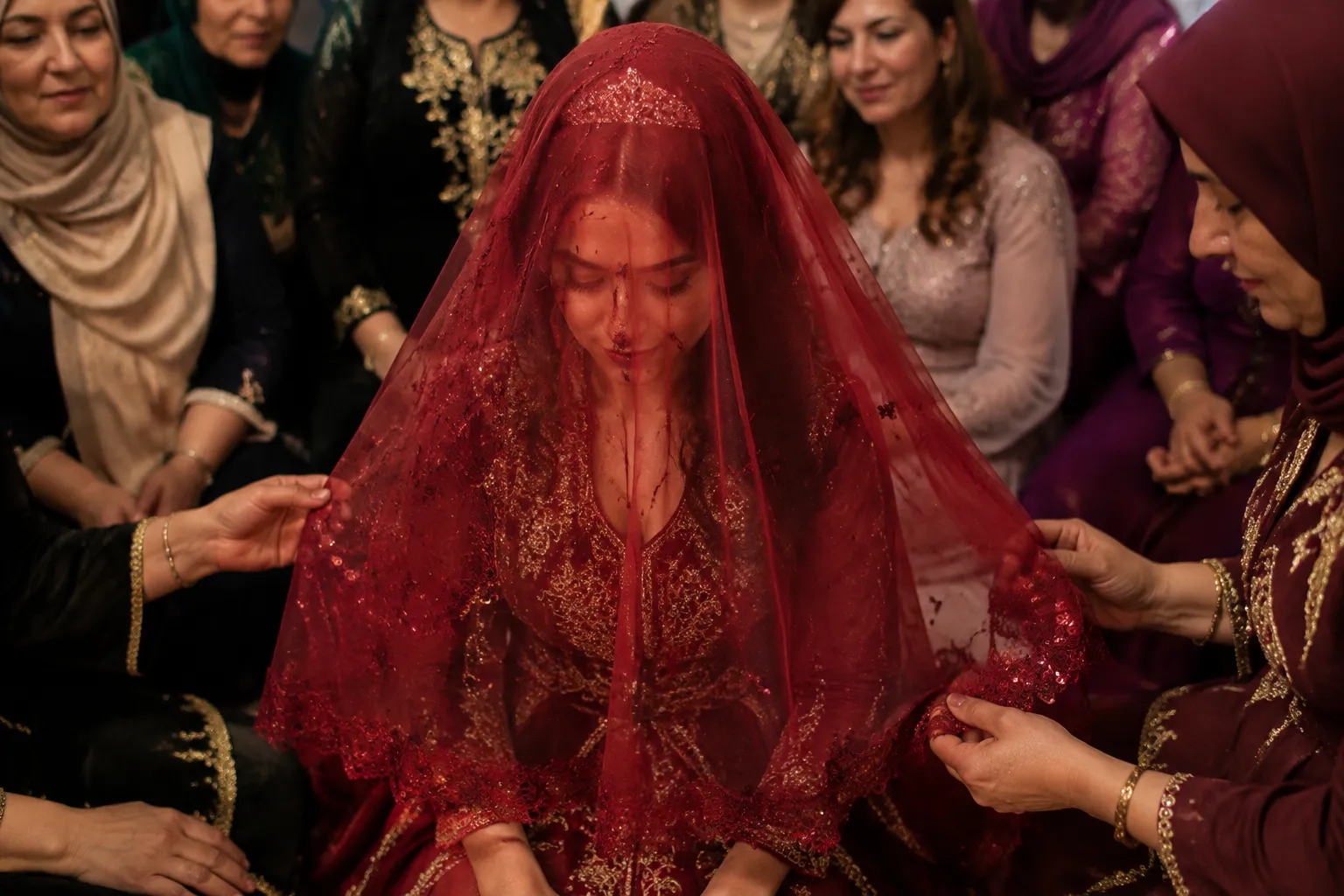
The veil may cover the bride's face during her entrance, remain in place while she sits for the henna ritual, or appear later during the departure from the family home. These moments are sometimes discussed together, although they can belong to different parts of the wedding sequence. The henna celebration is commonly called Kına Gecesi, while a later bride departure or retrieval may be called gelin alma.
What Does the Red Veil Mean?
The red veil is often associated with a bride's transition from one family setting to another. In particular regional and historical accounts, red clothing and coverings also carry associations with blessing, protection, strength, fertility, abundance, or hopes for a prosperous household.
These interpretations belong to particular traditions and social settings. The veil should not be treated as proof of a bride's virginity, consent, religious commitment, marital status, or character. Nor does wearing it show that a family follows one fixed ceremony.
The emotional meaning may be as important as the visual symbolism. Henna songs and ritual moments can express farewell, separation from the bride's parents, and hopes for the future. Celebration and sadness may appear in the same gathering, without one emotion explaining the bride's private feelings.
The most useful short answer is this: the red veil often marks a visible transition, while its particular meaning comes from the family's tradition, region, beliefs, and event format.
How Does the Bride Enter a Kina Gecesi?
There is no single Kina Gecesi bride entrance used by every family. A commonly described flow begins with preparation, followed by music, a candle procession if included, the bride's entrance or seating, henna application, and continued celebration.
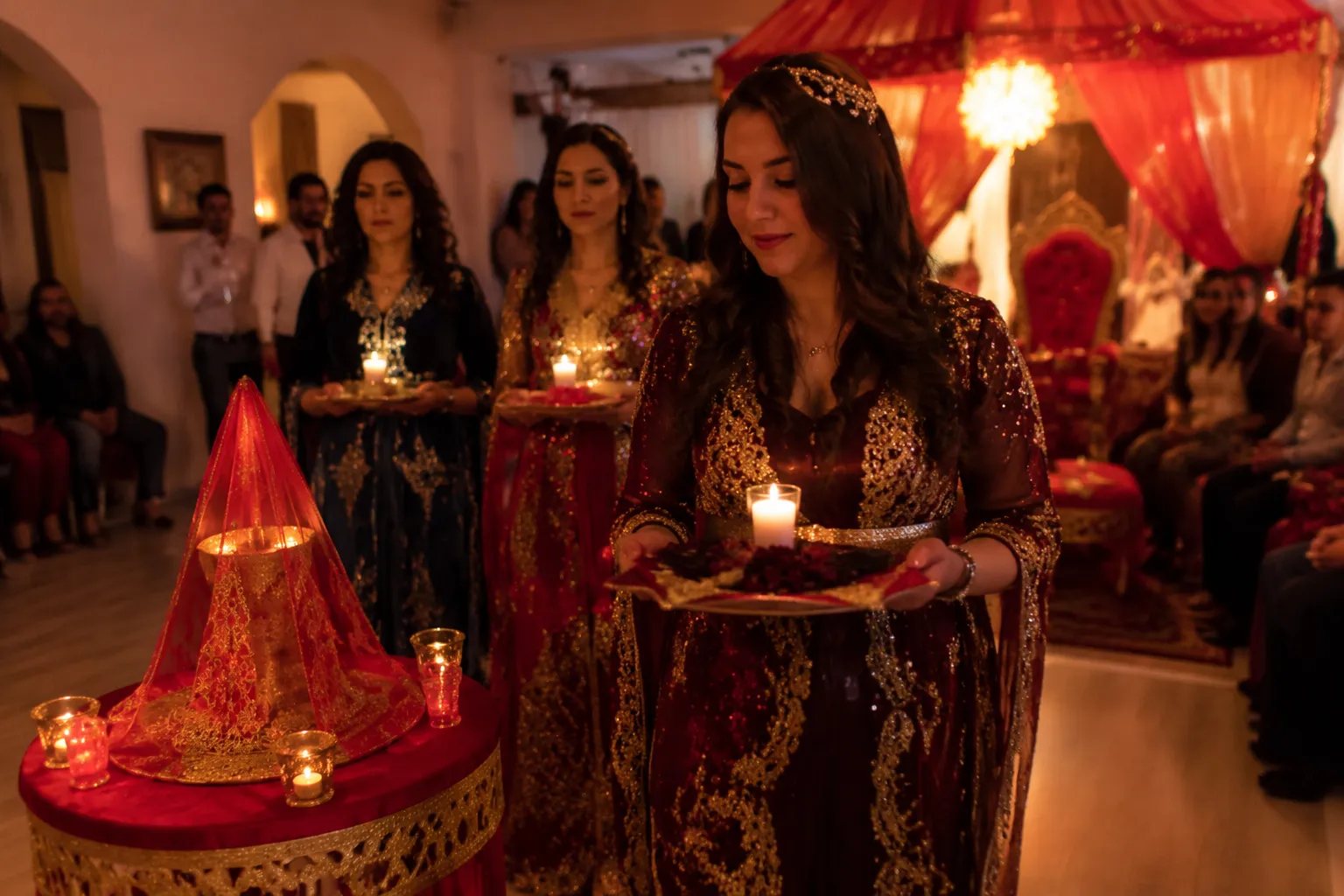
At a home celebration, the bride may change into a bindallı or another special henna outfit before the ritual begins. Some regional descriptions feature red clothing with metallic thread, sequins, or other ornament, followed by a red covering placed over the bride's head.
Women or younger relatives may carry candles and walk around the bride. The music may move from lively dancing to songs associated with henna, farewell, or family separation. The bride then sits in a central place while relatives and guests gather around her.
At some salon receptions, the same idea becomes planned venue choreography. Staff may dim the lights, clear a route across the dance floor, and position a chair or ceremonial seat. Those arrangements belong to the venue's event plan, not to a universal cultural script.
Other couples keep the entrance informal, use the veil only for photographs, or choose a contemporary outfit. A shorter salon version may move directly from the entrance to henna application.
Who Accompanies the Bride?
The people involved can change considerably. Female relatives, close friends, the bride's family, and members of the groom's family may all have roles. In some descriptions, the groom's mother or another female relative applies the henna; elsewhere, a sister, aunt, sister-in-law, or close friend takes that role.
Some families prefer a woman whose marriage is regarded as happy to apply the henna. Regional field studies describe this expectation in particular settings, but it is not a general rule for every Kına Gecesi.
The groom may join the ritual at a salon reception or in a contemporary format. Other families keep the henna moment centered on the bride and women from her family. Religious practice, family preference, venue policy, and the couple's own choices can all affect participation.
Choose one person to answer questions from the venue and guests. A clear contact person helps prevent conflicting instructions about the entrance, music, photography, or henna timing.
When Is the Henna Applied?
Henna is commonly applied after the bride has entered or been seated, although the order varies. One described sequence has the bride enter in her henna clothing, sit in the center, and remain surrounded by women carrying candles. Songs, prayers, or elder blessings may come before the application.
In some regional accounts, the bride keeps her hand closed at first, with a gold coin placed in her palm before she opens it for the henna. This is a documented detail of particular practices, not a standard feature of every celebration.
The groom may also receive henna in some families or regions. Ask whether the couple wants a joint moment, a bride-centered ritual, or a shortened version for the salon schedule.
Before the entrance begins, the responsible person should have the following items ready:
- Prepared henna and a presentation tray
- Candles or battery-operated lights, subject to venue rules
- Gloves, wrapping material, or another hand covering
- A seat with enough space for attendants
- A clear route from the changing area to the ceremony space
- Music and microphone cues agreed with the venue
These are planning details rather than fixed ritual rules. The family can decide which elements carry meaning for them.
Family and Regional Variations
Regional studies show the red veil alongside different clothing, participants, and ceremony sequences. Gaziantep material describes a bride in a red bindallı and red head covering during the henna ritual. Çankırı material describes a bindallı or another formal outfit, with a red veil placed over the bride's head before henna application.
Descriptions from Edirne include candle-bearing participants, wishes or prayers from an older woman, and henna applied to both bride and groom in some settings. Other celebrations take place at the family home rather than in a dedicated venue.
These examples show recurring themes, but they do not establish a national ceremony sequence. A practice associated with Gaziantep, Çankırı, Edirne, Muğla, Isparta, or another region should be presented as a reference point for that family or community.
The veil may cover the face fully, rest over the back of the head, or be removed before the henna is applied. Some brides wear traditional clothing for the entrance and change into a white wedding dress later. Others keep one outfit throughout the evening.
Religious, Secular, and Diaspora Settings
A red veil can appear in a religious, cultural, or largely secular setting. Its presence does not establish a religious requirement.
Some families include prayers, Quranic recitation, or elder blessings. Others use songs, dancing, candles, and henna without formal religious elements. A secular family may keep the veil as a family symbol, a connection to regional heritage, or simply part of the planned entrance.
Diaspora weddings may combine household customs with contemporary venues and clothing. Research on Turkish-German weddings describes traditional henna clothing alongside Western-style wedding dresses, banquet settings, and adapted religious or cultural elements. This is better understood as adaptation to a particular family and setting than as departure from a single fixed standard.
For couples bringing together different family backgrounds, decide in advance:
- Whether both families will join the entrance
- Whether prayers or blessings are included
- Whether the groom participates
- Which clothing tradition is being used
- Whether the veil stays on during the henna
- Whether the ceremony takes place at home, in a salon, or elsewhere
These decisions give the venue and guests a clear version of the ceremony without presenting one family's choices as universal.
Guest Etiquette During the Entrance
Guests can treat the entrance as a planned family moment. Keep the route open when candles, a tray, or several attendants are involved, and avoid entering the procession for photographs unless the couple has invited guests to do so.
If the bride's face is covered, do not lift or move the veil. Applause, dancing, and singing should follow the family's chosen format. During prayers or blessings, guests may be expected to watch quietly and join the celebration afterward.
Some songs and rituals are associated with farewell and may bring tears. Do not interpret crying as proof that the bride is unhappy or unwilling. It may reflect the emotional weight of the moment, family memories, or the song itself.
A Flexible Ceremony Flow
- Guests gather while the venue prepares the entrance route.
- The bride changes into her chosen henna outfit.
- Music begins, with candles or a henna tray prepared if included.
- The bride enters or is escorted to her seat.
- The veil stays in place, is adjusted, or is removed according to the family's plan.
- Songs, prayers, blessings, or a short candle procession take place.
- Henna is applied to the bride, and possibly the groom.
- The gathering continues with dancing, food, and family photographs.
This is an adaptable example, not a required script. A salon reception with a fixed schedule may shorten several steps or combine them.
What the Red Veil Does Not Decide
The red veil is a cultural and family practice used in some Turkish and Turkish-diaspora celebrations. It does not determine a couple's civil status, replace a civil ceremony, or settle questions about registration.
Any appointment, paperwork, or registration question belongs to the relevant jurisdiction and should be checked with the registering office handling the couple's case. The ceremony plan should also be confirmed with the couple, the family members organizing the ritual, and the venue coordinator.
The guest-facing answer is simple: ask what the veil means to this family, when it appears, and how guests should participate. That local explanation is more useful than applying one regional interpretation to every Kina Gecesi.
Sources
- Metaphorical Language and Function of the “Bridal Pick-Up” Ritual in Anatolian Traditional Weddings with Its Origin and Reflections
- 'Mother Bring the Henna': Kına Gecesi and Fragmented Imaginations of the Nation-state
- Home Beyond Borders: Turkish Wedding Ceremonies as the Embodied Extension of Diasporic Space in German-Turkish Context
- ÇANKIRI'NIN KIZILIRMAK İLÇESİNDE “KINA GECESİ” VE “GELİN ALMA” GELENEĞİ ÜZERİNE
- Dance and Identity Construction in Political Rhythms in Prefecture of Edirne, Turkey
- KINA GELENEĞİ BAĞLAMINDA OLUŞAN SÖZLÜ ŞİİR ÜRÜNLERİNİN İŞLEVLERİ: GAZİANTEP ÖRNEĞİ
- Cultural Codes of Marriage Rituals in Anatolia: From Ritual to Word in the Context of Oral Culture